THE KIPPENBERGER CHALLENGE
   |

| BOOKSHOP | CHALLENGERS | NEWS |
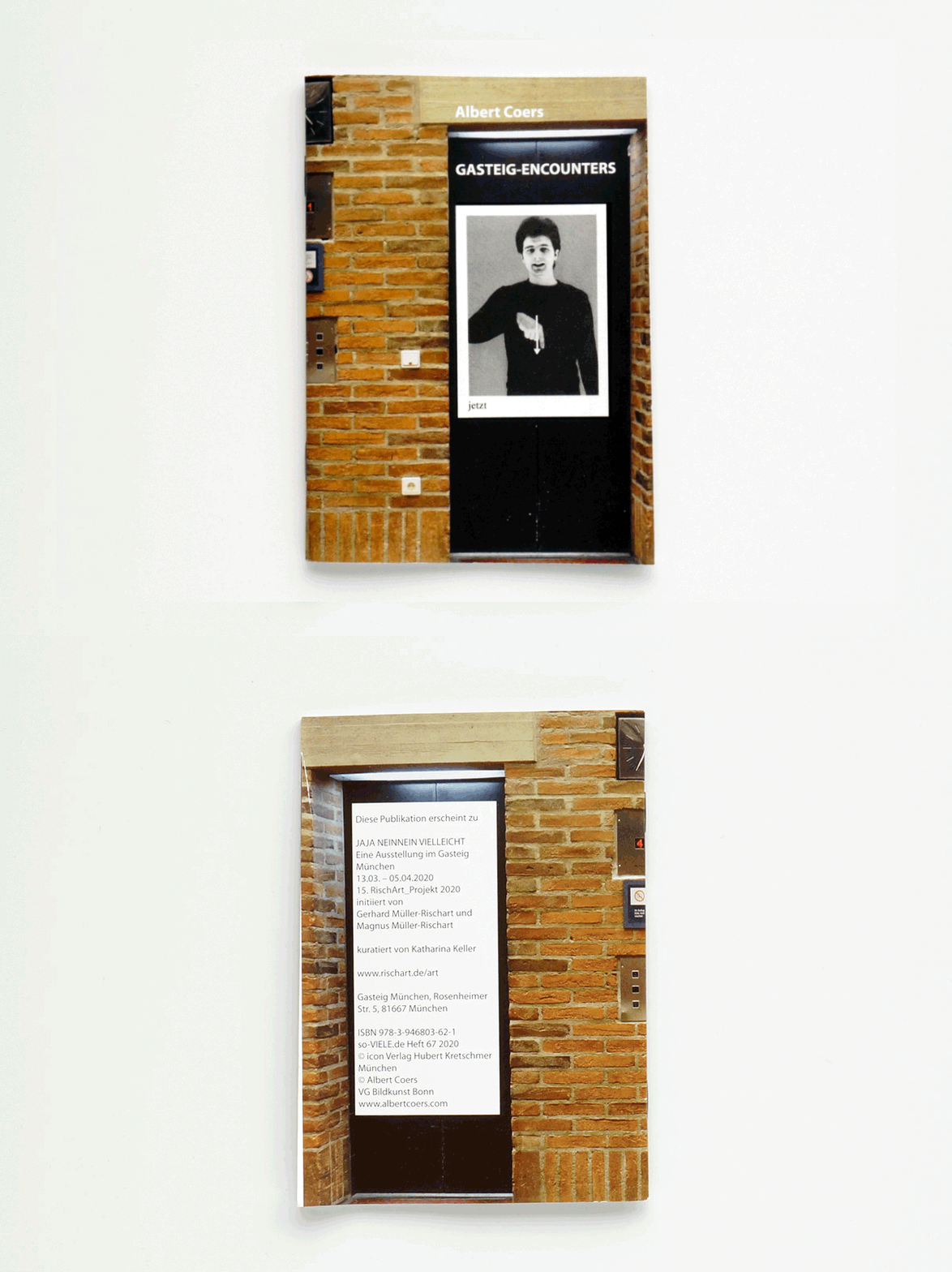
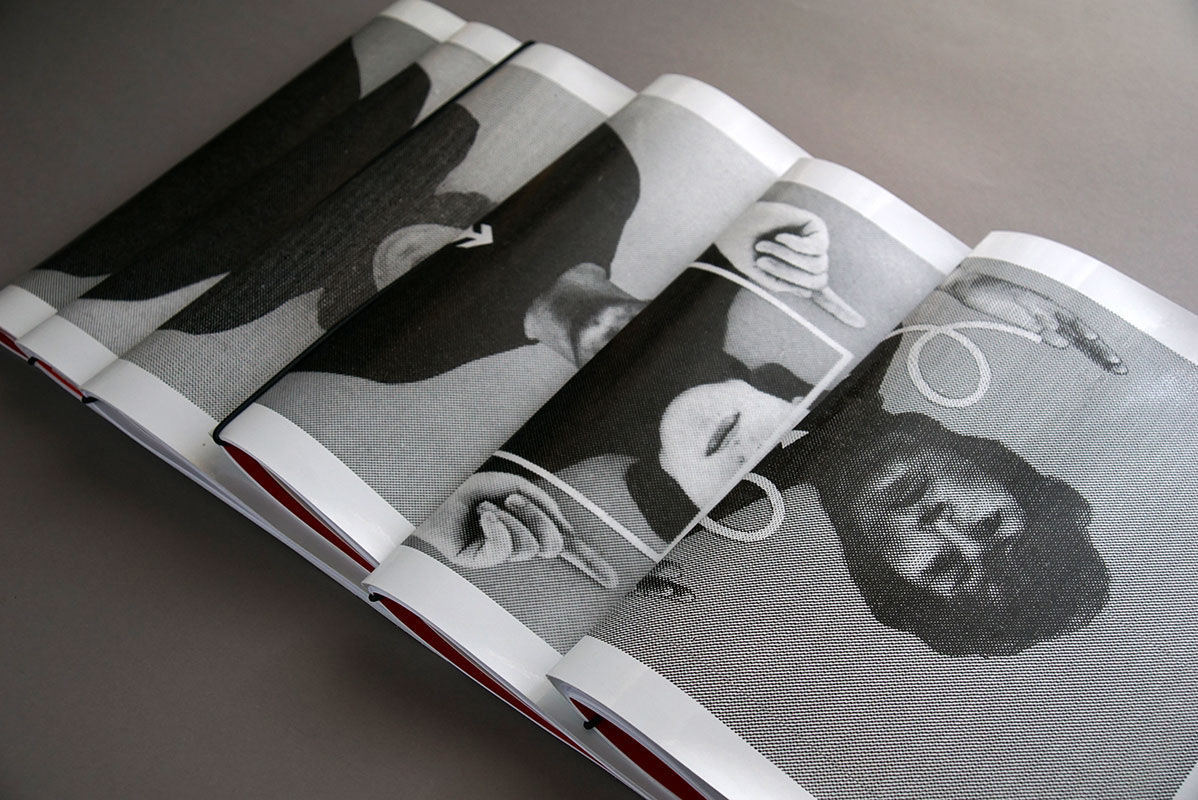
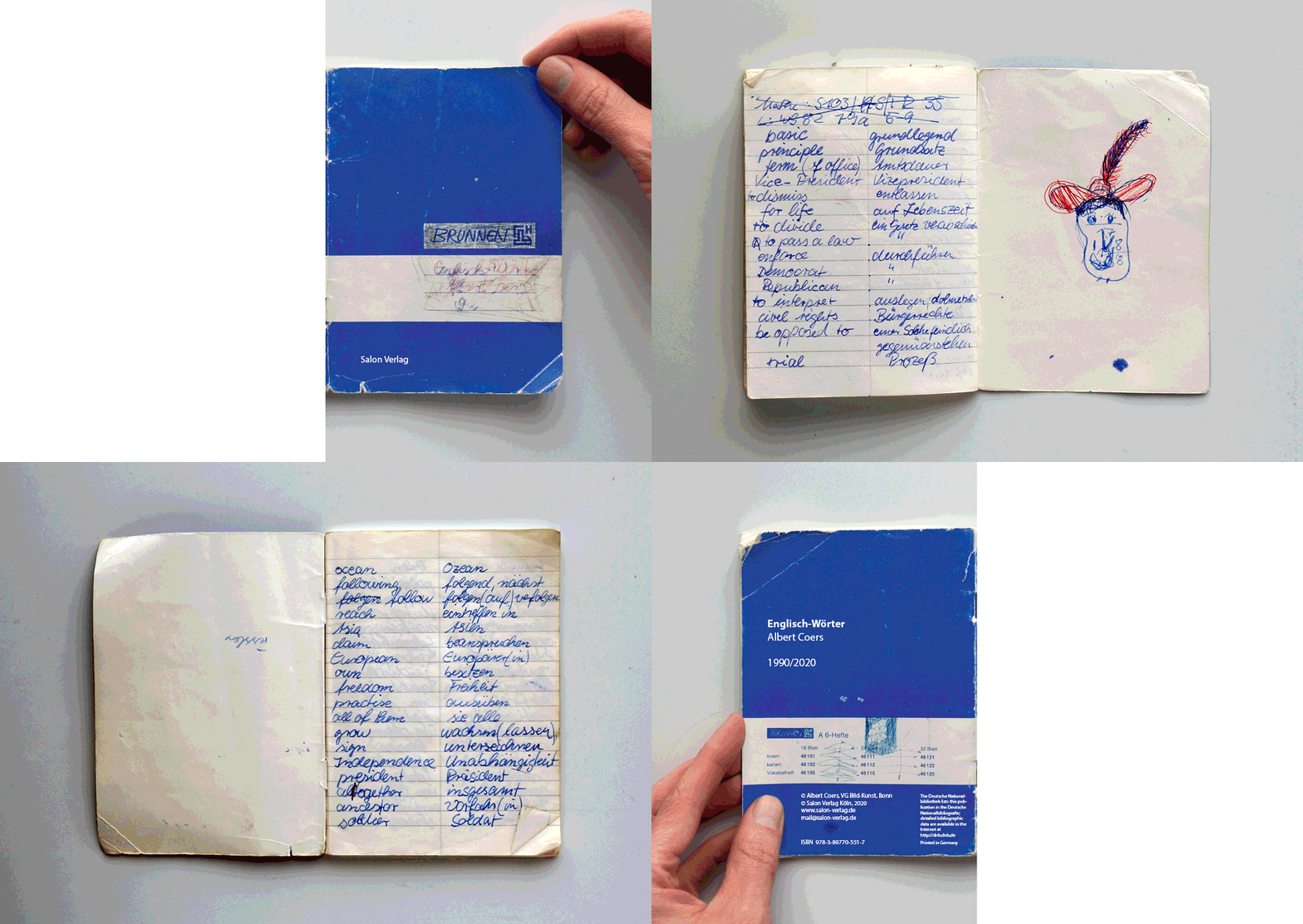
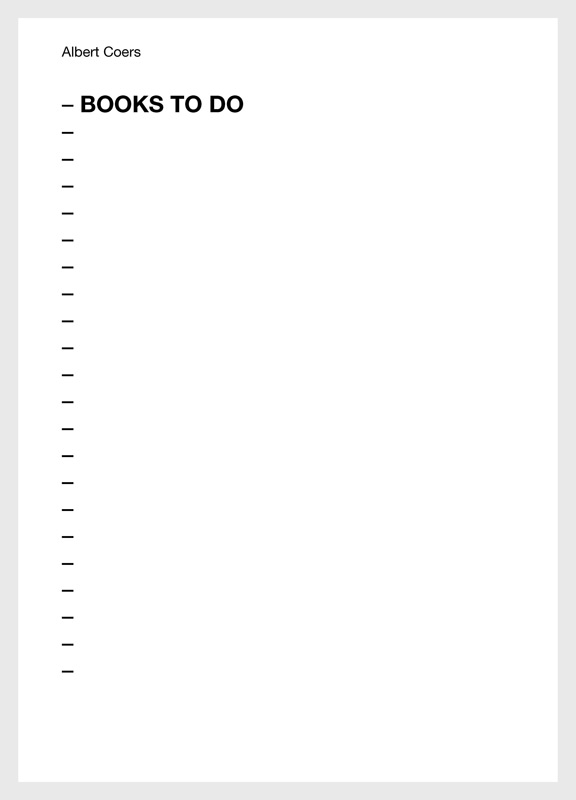
| Albert Coers 3 July 2020 – 3 Dec 2021 (including a ‘covid-extension’) 1 Gasteig Encounters (So-Viele-Hefte [So-many-booklets], Nr 67) ISBN 978–3‑94680–362‑1 10.5 × 14.8 cm, 36 pages, 16 ill. color, 14 black and white, stapled, published by icon, in an edition of 500 The booklet is published for JAJA NEINNEIN VIELLEICHT, 15th RischArt_Project, 13.03. — 05.04.2020 at Gasteig Munich. Language and communication are the theme of the exhibition. Albert Coers combines photographs of the postmodern architecture and interiors of the cultural center with images from a dictionary of sign language, published in East Berlin in 1985. The visual material dates from the same year as the Gasteig building and, apart from its fascinating visual aesthetics, was chosen for this reason. What is interesting is this temporal coincidence with simultaneous contrast: images and buildings come from different geographical areas, from East Berlin, capital of the GDR, in the north-east, and from Munich, at that time the "secret capital" of the Federal Republic, in the south. Very different aesthetics meet: here the black and white, the reduction of movements to graphic arrows, the strictness of an encyclopedia, there the lush postmodern architecture with an overabundance of colors, patterns, visual information. The terms are chosen so that they work in individual combinations, but also together with others, among themselves. 2 Gasteig Encounters Edition ISBN 978-3-94680376-8 21 × 29.7 cm, 14 sheets, envelope digital print on adhesive film, 6 different motifs, inner part print on paper plus a sheet of construction paper, red. Inserted print A4 and booklet 36 pages, 10.5 x 14.8 x cm. Held together with a black rubber band. Published by icon in an edition of 25 copies + 2 APs, signed and numbered The booklet is published for JAJA NEINNEIN VIELLEICHT, 15th RischArt_Project, 13.03. — 05.04.2020 at Gasteig Munich. Language and communication are the theme of the exhibition. Albert Coers combines photographs of the postmodern architecture and interiors of the cultural center with images from a dictionary of sign language, published in East Berlin in 1985. The visual material dates from the same year as the Gasteig building and, apart from its fascinating visual aesthetics, was chosen for this reason. What is interesting is this temporal coincidence with simultaneous contrast: images and buildings come from different geographical areas, from East Berlin, capital of the GDR, in the north-east, and from Munich, at that time the "secret capital" of the Federal Republic, in the south. Very different aesthetics meet: here the black and white, the reduction of movements to graphic arrows, the strictness of an encyclopedia, there the lush postmodern architecture with an overabundance of colors, patterns, visual information. The terms are chosen so that they work in individual combinations, but also together with others, among themselves. 3 Englisch-Wörter [English words] ISBN 978–3‑89770–551‑7 14.8 × 21 cm, 64 pages, stitched, published by Salon Verlag Cologne in an edition of 250 In 2020 Albert Coers found a 30-year-old exercise book from his English lessons. This booklet seemed so interesting that he photographed it and now presents it as an artist's book. The words, English on the left, German on the right, and their sequence give us a sense of the themes, word fields and stories. They join together associatively and result in Dadaistic-looking connections, e.g. "dream", "tree", "head" or "dial", "toothpaste", "handsome". The words are of astonishing topical as far as the present of the USA 2020/21 is concerned: on the first page "president", on the last page "civil rights" and "trial" – see the election campaign between Trump and Biden. The colors of the booklet can also be associated with the USA and its political symbolism: The blue of the cover can be read as a reference to the Democrats; blue is also the ink. The title "English words" is written in red, and further back a grotesque drawing is scribbled on a white background, giving the colors of the USA. Looking back, it is astonishing what one didn't know at that time and had to write down: That "ocean" means in German "Ozean", "follow" "folgen"? This is hard to believe in 2020, where English has become a natural second language for many people. Thus the booklet is also a reflection on language and language biographies. The booklet is in original size, but not reproduced as a facsimile, as a photographed object with a clear margin. Edges and shadows are thus also reproduced and the materiality, but also the character of the booklet as a reproduction is emphasised. The cover shows the hands of Coers holding the object. 4 Books to do Made in three versions; booklet A5, 12 p./print A4, 192 p./print A0, 12 p., folded to A4 Possible future publications are collected here, sketched out, in the form of a to-do list, as a collection of ideas and material, as self-stimulation and an ambitious work programme, with a touch of utopia … The list is constantly being edited and expanded and is printed as an artist's publication on certain occasions. 5 Sacred Distancing ISBN 978-3-948678-08-1 48 pages, 12 × 17 cm, German/English, published by Argobooks Berlin in an edition of 30 Churches all over the world, not only clubs and restaurants, have also had to deal with distance regulations and contact restrictions in the last 2 years. Albert Coers gathers photos of this in his artist booklet "Sacred Distancing": they are pictures of coloured stickers, arrows, coloured ribbons or signs indicating paths through church aisles and rows of pews in churches in Berlin, Munich, Venice, Münster, Sanary-sur-Mer and elsewhere. Churches traditionally see themselves as open to all people, but in practice this has presented challenges for small and large congregations. Anyone who has attended a service or wanted to visit a church in recent years has found themselves in these individual guidance systems which almost seem like artistic installations or choreographies. Questions arise about the relationship between (sacred) space and use, distance and proximity, pragmatics and aesthetics. The format takes up the series “Small Art Guides” published by Schnell & Steiner. The booklet is published on the occasion of the exhibition “Immunity” (Galerie der Künstler, Munich), where Coers transferred marking strips for entry and exit through the pews of a church as well as numbered chairs into the gallery space. An edition is published: copies 1–30 are accompanied by a sheet with three stickers, as they also appear in the photos. The first is pasted on the title and labelled with the number of the copy. 6 Albert Coers | Carsten Lisecki: TT ISBN 978-3-946803-88-1 56 pages, 21 × 27 cm, softcover, stapled, 30 colour illustrations, German/English, published by Icon publishing (Hubert Kretschmer) in an edition of 250 The book is published on the occasion of the exhibition Albert Coers | Carsten Lisecki: TT, 30.03.–25.04.2021, Galerie F6, Stiftung Künstlerdorf Schöppingen. The double letters TT stand for table tennis, thus for a common interest of Coers and Lisecki, but also for the working mode in which the exhibition came into being: in rapid alternation, in the playing back and forth of ideas and objects. Furthermore, the spacing attitude of non-contact ping-pong, not least in Corona times, with simultaneous playfulness, can be transferred to the exhibition: it is conceived as being visible and audible from the outside. The works move between inside and outside, going beyond the gallery space. The catalogue, at the same time an artist’s book designed by the actors, conveys the exhibition in page-long installation views that play with the space of the book. Texts contextualize them, by Albert Coers (“TT — Schöppinger Spiele”) and by Julia Haarmann, managing director of Künstlerdorf Schöppingen. Albert Coers works with found objects and linguistic material, among others from the library of the Künstlerdorf, which he collects and rearranges in space-related installations. Table tennis bats, records, letters begin to tell their own stories, for example in the space and sound installation UMLAUTE (Ä, Ö, Ü, Æ, Å, Ø), in the installation Platten [records/tiles] and in the video Klepsydra. On the occasion of the 100th birthday of Joseph Beuys, Carsten Lisecki shows current new interpretations of the social sculpture. With sound artist Benedikt Surmund, he also produces the K+K Land Dark Wave performance about the myth of regional supermarkets, processings and projections of logos, situational interventions with sports equipment and conferences at ping-pong tables. 7 Wer ist Albert? [6 × booklets] 14.8 × 21 cm, 48/12/12/12/16/12 pages, partly stapled, partly folded, laser printed black and white on 80gsm paper, and [4 × postcards] 14.8 × 21 cm, offset printed on 350gsm card stock, in folding box cardboard, 22.5 x 15.5 x 4.5 cm, in an edition of 20 I set out to find my first name in books by Goethe, Borges, Eichendorff, Ludwig Tieck, Uwe Timm, Markus Ostermair, André Aciman, Ingrid Noll, Christoph Scheuring, Andreas Izquierdo and others and ask the question: “Who is Albert?” (Werther). What image of a person with this name emerges? From the collection of reproduced passages I develop an artist’s book: a box with different “chapters”, independent booklets and a series of postcards. One booklet consists of full-page exhibition views from the installation “Who is Albert?” (2021) in the project space KloHäuschen Munich, onto which further quotations are pasted. Sentences are put together to form new narrative page sequences. In the process, the space of the book and the means of enlargement/reduction are played with. The bottom of the box is covered with a copy of cut-out quotations. I developed a dummy during a workshop by Backbonebooks / Claudia de la Torre, 21.–23.7.2021, Berlin. Other participants were Tali Neiman and Yasamin Saffarian. |